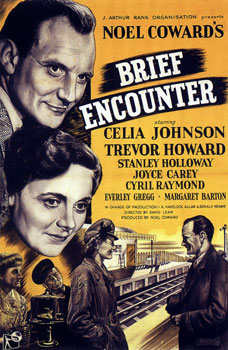
In his later and best-remembered works like Lawrence of Arabia, British director David Lean firmly established the clichés of Oscar bombast—exotic locations, grueling three-hour run-times, and subtly insinuated sexual deviance. But in his earlier films Lean was at the service of queen and countrymen, firmly solidifying many of the British cultural stereotypes that we Americans still enjoy today. The National Gallery of Art will show restored versions of eight of these films, and the director’s collaborations with Noel Coward alone are a survey of mid-century Englishness. The World War I naval drama In Which We Serve (1942) revels in stiff-upper-lip military romanticism. The comedy Blithe Spirit (1945) serves up the requisite droll English humor. Brief Encounter (1946)—the tale of a middle-class English housewife’s unconsummated affair with a married physician—is positively brimming with cloistered emotions, unfulfilled passion, and guilt. You’d need a plateful of Marmite on toast and a cupboard full of Balearic techno 12-inches to get more British than that. Lean’s subsequent Dickens adaptations—Great Expectations (1946) and Oliver Twist (1948)—begin to introduce the grandiose settings and epic tendencies that the director would use to great effect later on, but they too make the British Isles’ industrial grayness and bad food storyline linchpins. Some of those stereotypes are up for revision, but until some brave U.K. auteur is willing to tackle his country’s inexplicable devotion to Manic Street Preachers, Lean’s work will continue to endure. “David Lean Restored” runs through Sunday, Dec. 28, at the National Gallery of Art, East Building Auditorium, Constitution Ave. between 3rd and 7th Sts. NW. Free. (202) 727-4215. —Aaron Leitko
Sunday, September 14, 2008
David Lean Restored
In his later and best-remembered works like Lawrence of Arabia, British director David Lean firmly established the clichés of Oscar bombast—exotic locations, grueling three-hour run-times, and subtly insinuated sexual deviance. But in his earlier films Lean was at the service of queen and countrymen, firmly solidifying many of the British cultural stereotypes that we Americans still enjoy today. The National Gallery of Art will show restored versions of eight of these films, and the director’s collaborations with Noel Coward alone are a survey of mid-century Englishness. The World War I naval drama In Which We Serve (1942) revels in stiff-upper-lip military romanticism. The comedy Blithe Spirit (1945) serves up the requisite droll English humor. Brief Encounter (1946)—the tale of a middle-class English housewife’s unconsummated affair with a married physician—is positively brimming with cloistered emotions, unfulfilled passion, and guilt. You’d need a plateful of Marmite on toast and a cupboard full of Balearic techno 12-inches to get more British than that. Lean’s subsequent Dickens adaptations—Great Expectations (1946) and Oliver Twist (1948)—begin to introduce the grandiose settings and epic tendencies that the director would use to great effect later on, but they too make the British Isles’ industrial grayness and bad food storyline linchpins. Some of those stereotypes are up for revision, but until some brave U.K. auteur is willing to tackle his country’s inexplicable devotion to Manic Street Preachers, Lean’s work will continue to endure. “David Lean Restored” runs through Sunday, Dec. 28, at the National Gallery of Art, East Building Auditorium, Constitution Ave. between 3rd and 7th Sts. NW. Free. (202) 727-4215. —Aaron Leitko

Wednesday, September 10, 2008

Sunday, September 7, 2008
Alexander Kluge

If Alexander Kluge wasn’t the first auteur to apply the gray colors and paranoia that defined New German Cinema, then he was close at hand and holding a paintbrush. The Goethe-Institut’s retrospective on Kluge, “Film Will Survive,” features four of the director’s longer works, accompanied by relevant short films, beginning Sept. 8 with Kluge’s early triumphs Brutality in Stone (1966) and Yesterday Girl (1966). Brutality in Stone, an 11-minute montage assembled from footage of the ruined Nuremberg rally grounds, contemplates decaying Nazi architecture as a silent witness to Word War II atrocity. While that may seem old hat in the era of the History Channel, it resonated deeply back when Germany was desperately trying to look away and start over. Yesterday Girl, Kluge’s first feature-length film, critiques postwar German society by following an young and emotionally desolate Jewish woman from betrayal to betrayal as she tries to get ahead, ultimately descending into a life of petty theft. By using on-set improvisation, wild juxtapositions, and jarring narrative leaps, Kluge helped to establish a distinctive world for German cinema. But it’s a slightly harrowing one, where a common person’s soul generally gets crushed and birds don’t sing but scream in pain. The series runs to Monday, Sept. 29, at the Goethe-Institut Washington, 812 7th St. NW; see Showtimes for this week’s films; see goethe.de/washington for a complete schedule. $6. (202) 289-1200.


Wednesday, September 3, 2008

Subscribe to:
Posts (Atom)


